Baker’s Percentages Explained: Unlock the Secret Language of Great Baking
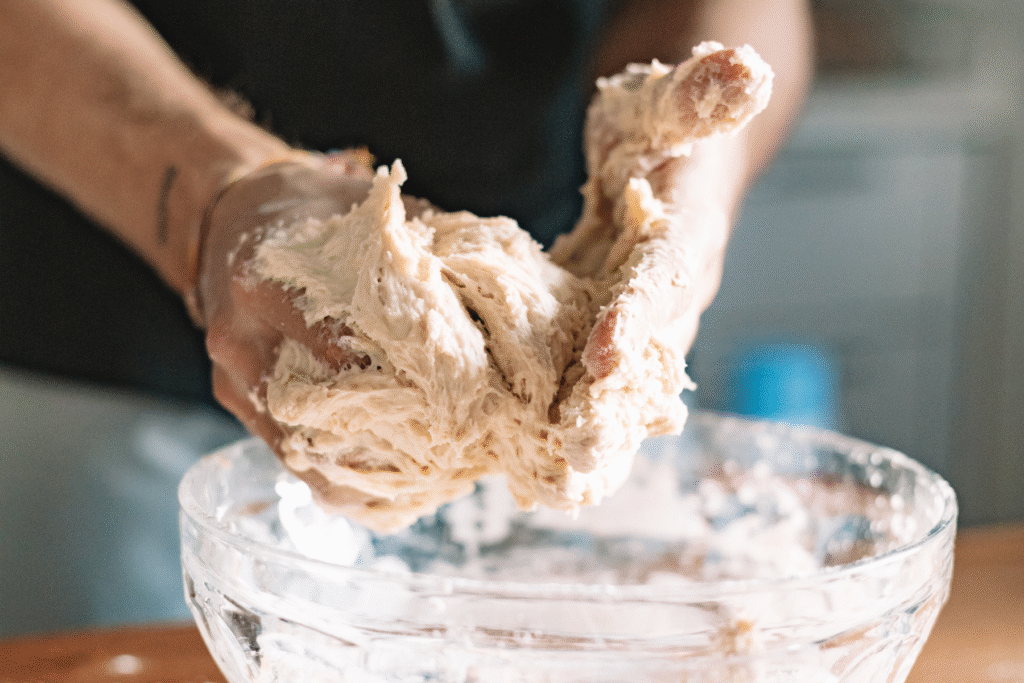
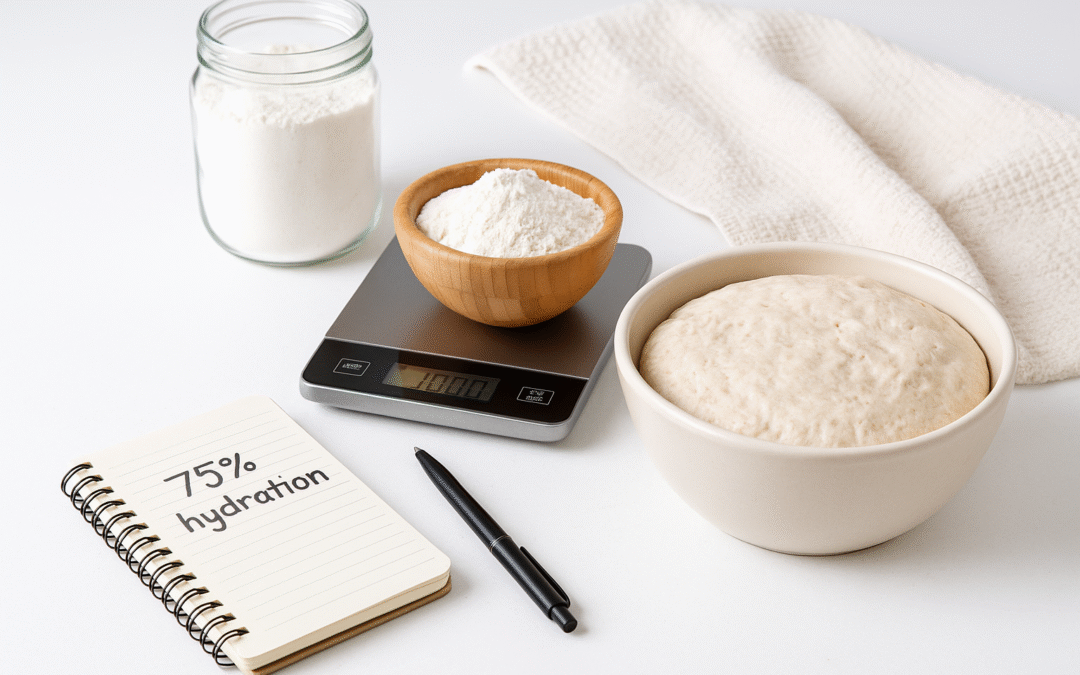
I remember the first time I saw a sourdough formula that said “75 % hydration.” I blinked. Then blinked again. Was this algebra? A secret code? I didn’t know it yet, but I was looking at my first example of baker’s percentages, the secret language that every great sourdough baker eventually learns to speak.
Turns out, that little number changed everything.
Once I understood baker’s percentages, I stopped guessing and started baking with confidence. Suddenly my loaves weren’t surprises — they were consistent, balanced, and exactly how I wanted them to be.
So grab a cup of coffee and your scale. Let’s decode this together.
What Are Baker’s Percentages and Why They Matter
Baker’s percentages (or “baker’s math”) express every ingredient as a percentage of the flour weight, not the total dough weight.
Flour is always 100 %, and everything else — water, salt, starter, honey, or butter — is compared to that number. This simple “baker’s math” keeps every bread formula consistent, whether you’re making one loaf or ten. In other words, flour sets the standard for every calculation.
👉 A Simple Example of Baker’s Math
Example:
If you use 1000 g flour and 750 g water, your dough is 75 % hydration because
750 ÷ 1000 = 0.75.
It’s that simple. From that moment on, the entire bread world starts to click into place.
Why You’ll Fall in Love with Baker’s Math
It lets you:
- Scale any recipe up or down perfectly
- Compare formulas from different bakers instantly
- Adjust hydration for texture and crumb
- Balance flavor and fermentation time
- Create your own signature recipes
It’s the difference between copying a song and composing your own.
Baker’s Percentage Formula Explained
Once you understand this baker’s percentage chart,
you can quickly scale or modify any recipe without guesswork.
Ingredient % = (Ingredient Weight ÷ Flour Weight) × 100. Example:
| Ingredient | Weight (g) |
Baker’s % |
| Bread Flour | 800 | 80% Total Flour |
| Whole Wheat Flour | 200 | 20% |
| Water | 750 | 75% |
| Starter | 200 | 20% |
| Salt | 20 | 2% |
Add the flour weights together to get your 100 %. Everything else is relative to that.
💦 Understanding Hydration in Baker’s Percentages
Hydration percentage — the ratio of water to flour — determines how your dough feels and bakes. Understanding this part of baker’s math is key to mastering texture.
| Hydration | Texture |
Perfect For |
| 60–65 % | Tight crumb, firm structure | Sandwich loaves, enriched breads |
| 70–75 % | Balanced, open crumb | Boules, batards |
| 80 % + | Loose, glossy, holey | Ciabatta, focaccia |
A 70 % dough feels like smooth play-dough. By contrast, at 80 %, it’s alive — soft, elastic, and slightly sticky, like a marshmallow that wants to stretch forever.
Typical Baker’s Percentages in Sourdough
| Ingredient | Common Range | What It Does |
| Starter | 10–30 % | Controls fermentation speed and flavor |
| Water | 65–85 % | Determines crumb and texture |
| Salt | 1.8–2.5 % | Balances flavor, slows fermentation |
| Honey / Sugar | 2–10 % | Adds sweetness and crust color |
| Fat (Butter / Oil) | 1–15 % | Tenderness and richness |
| Milk | 10–30 % | Softens and Enriches |
| Eggs | 10–25 % | Color, structure, flavor |
These numbers form the backbone of every sourdough ratio you’ll ever use, from crusty boules to soft sandwich loaves.
How to Build Your Own Baker’s Percentage Formula
This kind of baker’s math lets you design new recipes confidently — adjusting your sourdough ratios to match your taste or texture goals.
Say you want:
1000 g flour
75 % hydration
20 % starter
2 % salt
| Ingredient | % | Grams |
| Flour | 100% | 1000 |
| Water | 75% | 750 |
| Starter | 20% | 200 |
| Salt | 2% | 20 |
Need half the batch?
Just cut the flour to 500 g and apply the same percentages, math magic,
no guessing, or just cut the ingredients in half.
Tools for Working With Baker’s Percentages
Disclosure: This article includes affiliate links. If you click and make a purchase, I may earn a small commission at no cost to you. As an Amazon Associate I earn from qualifying purchase. All opinions and product recommendations are my own.
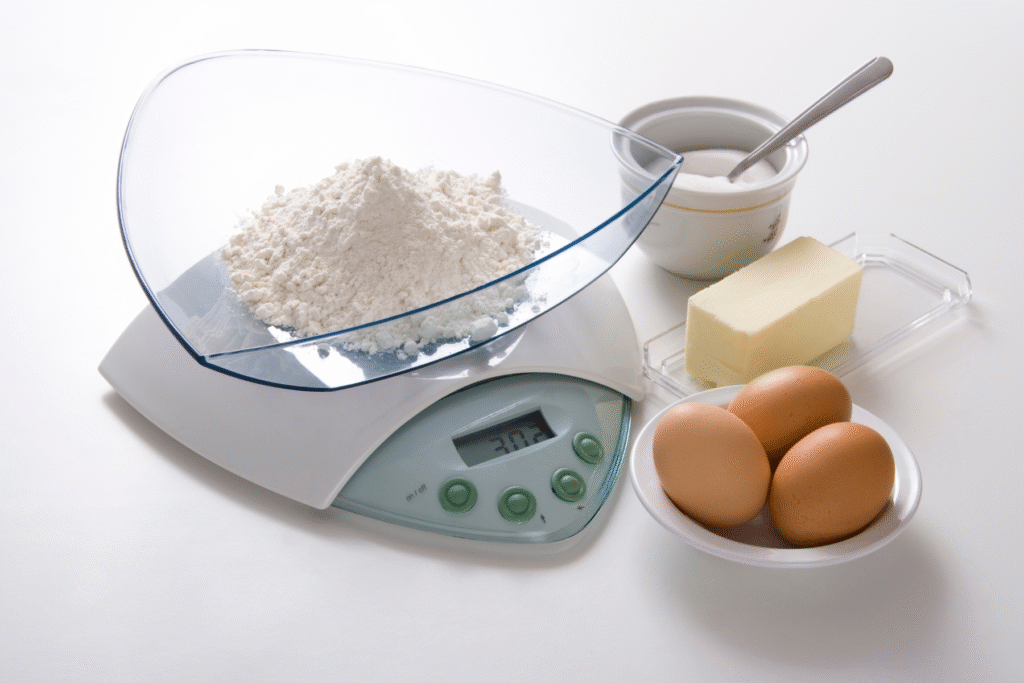
Digital Kitchen Scale – accuracy is everything. I love this OXO Precision Scale
Baking Notebook – jot down every experiment and hydration tweak.
Baker’s Percentage App – A simple baker’s percentage calculator (or any bread formula app) can save time and prevent scaling mistakes.
Dough Thermometer – remember, time + temperature + ratios = consistent bread.
💡 Don’t Forget the Starter’s Hydration
If your starter is 100 % hydration (equal parts flour and water), it already contributes to both totals.
So:
Starter = 200 g → 100 g flour + 100 g water.
Your total flour and total water both increase by those amounts.
This tiny detail explains why two “identical” recipes can feel different. Ultimately, it’s all in the math.
Quick Style Comparison
| Style | Flour (g) | Water (g) | Starter (g) | Salt (g) | Hydration % | Texture |
| Rustic Country Loaf | 1000 | 780 | 200 | 20 | 78% | Open, chewy |
| Sandwich Loaf | 1000 | 650 | 150 | 20 | 65% | Light, bubbly |
| Focaccia | 1000 | 850 | 100 | 25 | 85% | Light, bubbly |
| Brioche | 1000 | 500 | 200 | 20 | 50% | Rich, tender |
How to Experiment (Without Fear)
- Add 2–3 % more water for a looser, more open crumb.
- Increase the starter to 20–25 % for faster, milder fermentation.
- Lower the starter to 10–15 % for slower fermentation and a tangier flavor.
- Keep notes — over time, they’ll become your personal bread diary.
Did you know?
More starter doesn’t just make your dough rise faster, it also limits the time acids can develop, giving you a softer, sweeter flavor profile. Less starter slows things down, deepening the sourness.
Every tweak teaches you how your dough thinks.
A Quick Reality Check
When I started baking, I tossed ingredients together and hoped for magic. Some loaves were miracles; others… flat and dense.
Learning baker’s percentages felt like unlocking the language my dough had been trying to speak all along.
Now, every time I mix flour and water, I know exactly what I’m creating — not guessing, not hoping. Just baking on purpose.
Advanced Baker’s Percentages
Once you’ve mastered the basics of baker’s percentages, you can explore more advanced topics like:
- Prefermented Flour (PFF) — how much of your total flour comes from your levain
- Adjusting for mix-ins (nuts, seeds, dried fruit) without unbalancing your dough
- Spreadsheet tracking for scaling formulas and managing large batches
For a deeper technical dive, visit The Perfect Loaf: Introduction to Baker’s Percentages
Maurizio’s guide is one of the clearest step-by-step explanations out there.
Baker’s percentages — or baker’s math — are more than numbers; they’re a language.
When you understand your hydration percentage and ratios, you bake with intuition and confidence. No more mystery, no more guessing, just dough that behaves exactly how you want it to.
And trust me, nothing feels better than pulling a perfect loaf from the oven and knowing… you did the math and the magic.
Next, read:
Hydration Explained — How to Fix Sticky or Dry Dough →
Beginner Sourdough Bread Recipe (Artisan Loaf) →
Baker’s Percentages FAQ
Real Questions Bakers Ask
1. Do I count the flour in my starter?
Absolutely. All flour = 100 %, including the flour inside your starter or levain.
2. What if I mix different flours?
Combine them to total 100 %. For instance, a bread formula that’s 70 % bread flour and 30 % spelt still follows the same baker’s math principles.
3. Is wetter dough always better?
Not unless you enjoy chasing slime across your counter. Each style has its own sweet spot.
4. Do milk and eggs count as water?
Partly. They contain moisture, so advanced bakers sometimes include them in total hydration.
5. Where should I start?
Try 70 % hydration. It’s forgiving, easy to handle, and makes gorgeous loaves.